Why it’s so hard to feel like a real writer with ADHD

Let me guess: you’re not really a writer? As an ADHD writing coach, I hear this all the time from the hundreds of ADHD writers I’ve worked with. “I’m not really a writer, I just dabble in writing in my free time.” “I’m not really a writer, I’m just a professional who needs to write a lot.” “I’m not a real writer with ADHD, I’m an academic.” But these kinds of messages can really have adverse effects. So let’s get into why it’s so hard to feel like a real writer with ADHD and, of course, how you can overcome this challenge.

Real writers with ADHD and Impostor Syndrome

Quick note

Before we really get into the ADHD-specific situation, a quick note here. I am not saying that ADHDers are the only people feeling this way. In fact, I’ve noticed that most creatives feel like an impostor. However, the same is true for ADHDers who are not trying to be creative at all. This means that an ADHD writer gets the double whammy. And if in addition you to being neurodivergent you also belong to another marginalized group, that adds even more layers of self-doubt.

So, even though impostor syndrome is not a uniquely ADHD thing, it is especially  relevant to us – and there are some aspects that make our impostor syndrome unique. 

ADHD writers and impostor syndrome (for real this time)

That being said: most (real) writers with ADHD I’ve met feel like an impostor. Some even start their free discovery call with me with, “I’m not even sure I should be here.”

So why would this be the case?

My theory is that it has a lot to do with the way we were brought up.

You see, I think there are two kinds of ADHD symptoms: those that are caused by actual differences in our brains and bodies, and those that were caused by growing up neurodivergent in a neurotypical world.

I think our impostor syndrome is mostly caused by the latter.

So what’s wrong with us?

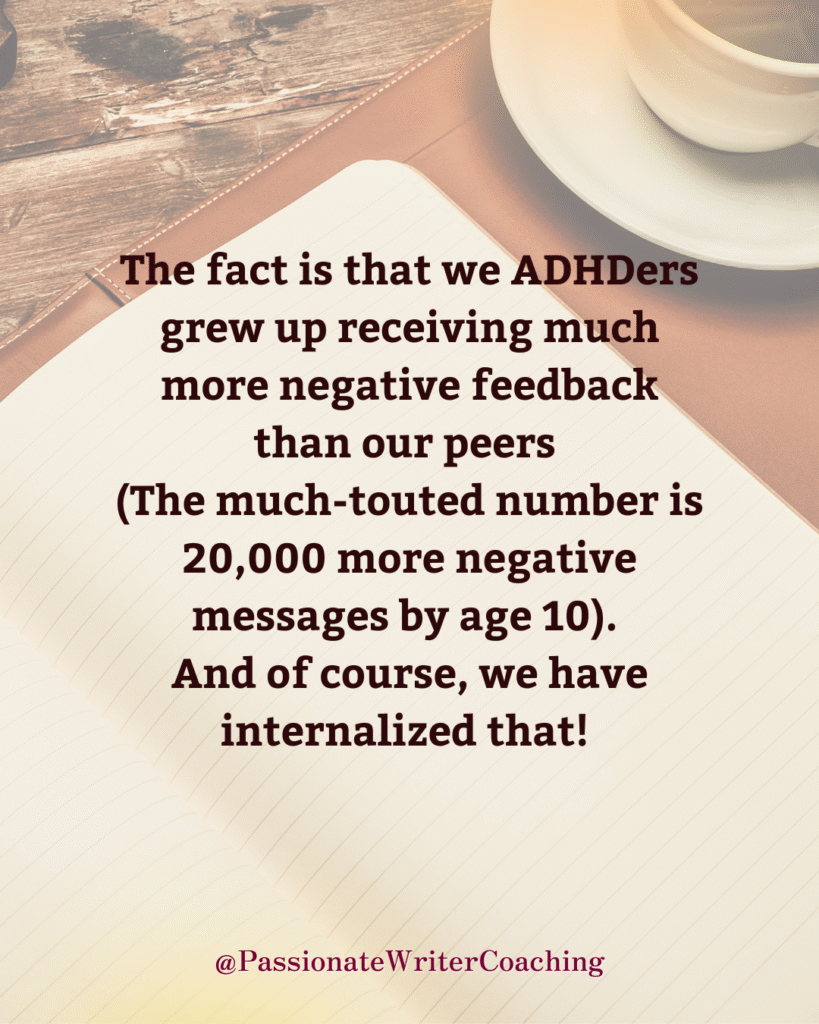
The fact is that we ADHDers grew up receiving much more negative feedback than our peers (The much-touted number is 20,000 more negative messages by age 10). And of course, we have internalized that! This has caused the belief that when we’re different, we’re doing something wrong.

And with all the messages online about how “real writers” work, that has real consequences!

How this shows up for me

Last week, I received an email from a commissioning editor who wanted to talk to me about my book Writing Traps. Of course, this was great news, and I’ve been floating above cloud nine ever since! But in between the moments of joy and excitement, I also realized something: Only hours earlier, I had changed a social media post, to make it sound less like I am an ADHD writer. Because really, I don’t feel like one at all.

Do I help ADHD writers? Absolutely! Do I consider each and every one of them real writers with ADHD? Yep, without a doubt. So then why don’t I call myself one?

Well, I think it’s because the combination of our internalized childhood narratives and the narratives online combine to make a toxic mix. And neither of those narratives were created by and for ADHD writers!

The stories we tell ourselves about “real writers” with ADHD

Here are some of the stories my clients and I have told ourselves over the years:

✒️ A real writer writes every day.

✒️ A real writer publishes X pieces per year.

✒️ A real writer writes full-time.

✒️ A real writer enjoy writing every time they do it.

✒️ A real writer…

Does that sound familiar? Well, to me, it sounds decidedly un-ADHD-friendly.

For writers with ADHD, consistency is a huge challenge (and probably a fiction). Novelty motivates us more than anything else, and our interest fluctuates more than it does for most, which can impact not only our prolificness but also the quality of our work.

So what can we do?
Create your own ADHD-friendly writing story

One of the most powerful ways to build a new narrative is to be in a room where the old one doesn’t hold.

That’s what the Writers’ Room is. Every week, I open a virtual writing space specifically for ADHD writers — people who write in bursts, who lose momentum, who rewrite the same paragraph seventeen times, and who still show up. When you write alongside people like that, something shifts. The “real writer” standard stops being the neurotypical one. It becomes yours.

The Writers’ Room runs on Tuesdays and is pay what you can — including free if that’s what you need right now. 

ADHD-tailored narratives

Final points on "real writer" narratives

So we now know why it’s so hard to feel like a “real writer” with ADHD and what narratives our inner critics use to keep us stuck, insecure, and ashamed. And I hope I’ve also convinced you of why we need to change those narratives.

No? Not yet?

Then imagine what happens if you don’t! You’ll continue to feel like an impostor. This will make you rewrite the same sentence over and over again. It might make you give up on projects because you think they’re not good enough. Or it might keep you from getting your work out there. In this future, you are constantly battling an internal enemy.

But it doesn’t have to be that way. The narrative changes when you stop writing alone. Join a room full of ADHD writers who are building their own stories, and you’ll find that the confident, capable writer you’re looking for has been there all along — they just needed the right mirror.

Join the Writers' Rooms

Fill out the form below and I’ll send you an invitation the day before every Writers’ Room. 

And remember: for this service, I only charge pay what you can!